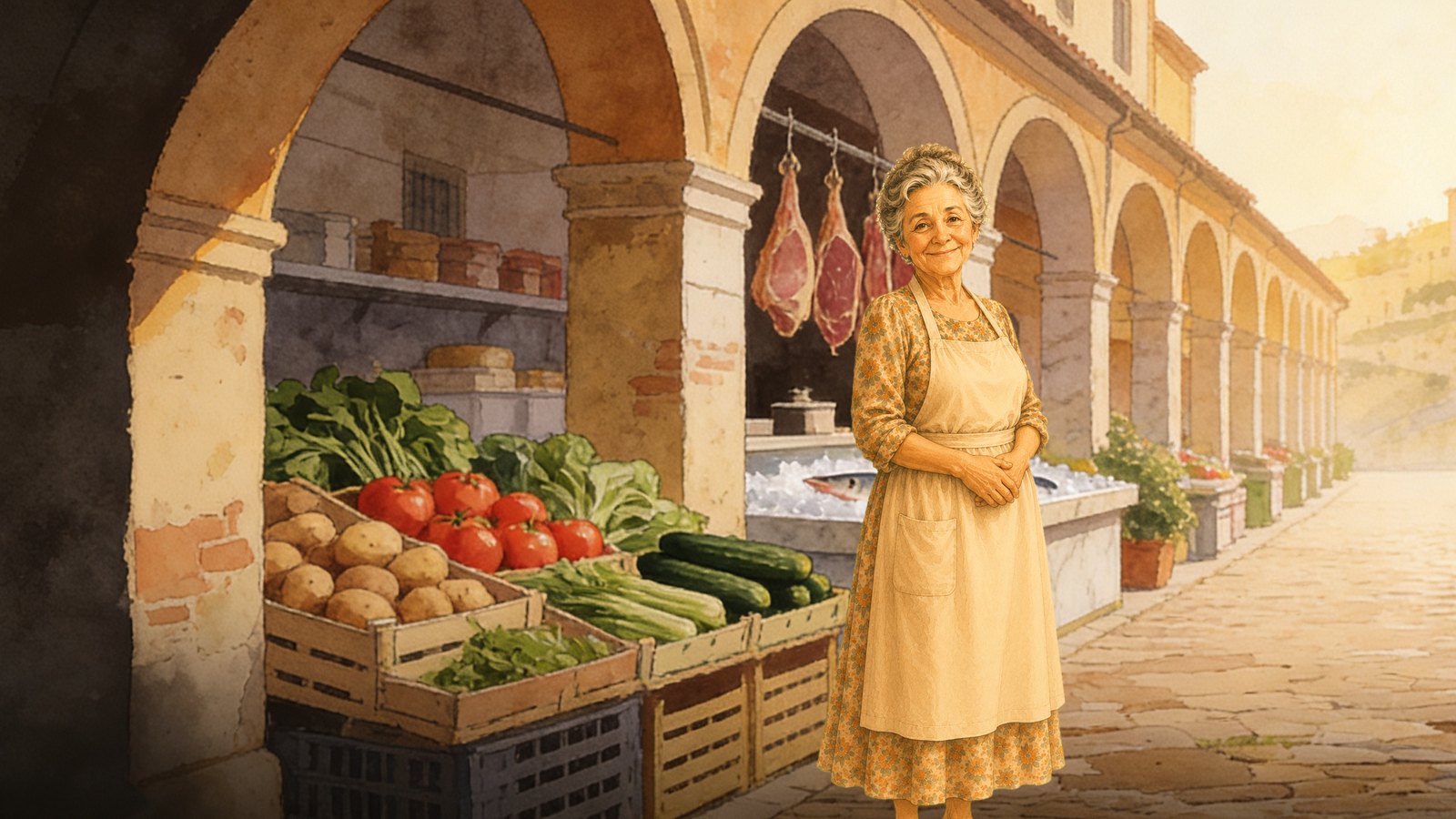
A woman at a market asks for ripe peaches. A nonna insists that the tomatoes were better yesterday. Someone arrives late for coffee, apologizes, and tells a small, familiar story. If you can understand what is happening, even without knowing every word, Italian stops feeling like a code to crack. It starts to feel like a place you can enter.
That is the heart of how to learn Italian through stories. Rather than collecting disconnected words and grammar rules, you meet Italian inside situations that give each phrase a job. The language has faces, feelings, repetition, and a reason to be remembered.
Why stories help Italian stay with you
A word on a flashcard can be technically correct and still disappear by tomorrow. Mercato means market, but the word becomes more durable when you see Nonna choosing fruit, asking the price, and carrying a heavy bag home. Context helps your brain understand not only what a word means, but when and why someone would say it.
This is especially helpful in Italian, where small words and verb endings carry a great deal of meaning. You may memorize voglio as “I want,” then freeze when you hear vuoi un caffè? in a real conversation. In a story, the exchange makes the pattern clear: Sofia wants coffee, her friend asks a question, and the answer follows naturally. You are not trying to retrieve a rule under pressure. You are following a moment.
This approach draws on comprehensible input, a tradition associated with researcher Stephen Krashen. The basic idea is simple: acquisition grows when learners understand language that is a little beyond what they already know. Not an opaque flood of fast native speech. Not a worksheet made of isolated blanks. Language you can mostly follow, with enough new material to gently stretch you.
Stories also make repetition feel less like repetition. A useful phrase can return in a new scene: at the bar, on the train, during a family lunch. Each re-encounter strengthens the connection without asking you to chant a word list. Researcher Paul Nation’s work on vocabulary learning emphasizes the value of repeated encounters, and stories offer those encounters in a form people actually want to revisit.
Start with stories you can truly understand
The best story for learning is not necessarily the most famous novel, the most sophisticated film, or the podcast everyone recommends. At the beginning, those can be lovely goals and frustrating study materials. If you understand only a few scattered words, your attention goes into survival mode. You may finish a chapter or episode feeling dutiful, but unable to say what happened.
Choose material where you can follow the main action without translating every sentence. You should know who is speaking, what they want, where they are, and what changes by the end. A few unfamiliar words are useful. A page full of them is usually too much.
For a beginner, a short, slow story about ordering breakfast or visiting family can teach more usable Italian than a difficult news article. For an early intermediate learner, a richer scene with opinions, misunderstandings, and everyday past events may be the right next step. The level that works depends on your current comprehension, not on how long you have been “studying Italian.”
Listening and reading together can be particularly kind to the beginner brain. Hearing the sounds while seeing the words helps you connect Italian spelling, rhythm, and meaning. Italian is often pronounced more consistently than English, but connected speech can still feel quick at first. A slower voice gives you time to notice where one word ends and the next begins.
A gentle way to work with each story
First, listen or read for meaning. Resist the urge to pause at every unknown word. Ask yourself simple questions: Who is here? What happened? Is the person happy, worried, hungry, late, surprised? Those answers prove that you are processing Italian as a message, not merely recognizing individual items.
Then return to the story. On a second pass, notice a few phrases that appear again or seem useful for your life. Maybe it is che cosa vuoi? (what do you want?), non lo so (I don’t know), or andiamo insieme (let’s go together). Keep the phrases connected to the scene where you met them. That mental picture is part of the memory.
A third encounter can be quieter still. Listen while walking, folding laundry, or making coffee. Read along if you need support. When the story begins to feel easy, that is not a sign that it has stopped teaching you. Ease is evidence of recognition becoming more automatic.
Gentle comprehension checks are useful here. A simple question such as “Did Sofia go to the market or the bar?” asks your brain to confirm meaning without turning the experience into a test. This kind of low-stakes recall helps reveal what you understood and what needs another encounter.
Let grammar appear before you analyze it
Grammar matters. It helps you express yourself clearly, notice patterns, and eventually make choices with confidence. But grammar explanations are often more useful after you have seen a pattern doing real work.
Imagine you repeatedly hear vado al mercato, vai al mercato?, and andiamo al mercato. Before anyone gives you a chart, you have already felt that these forms belong together and that they involve going. A short explanation can then organize something your mind has begun to recognize.
This is one reason story-based learning can feel more natural than grammar-first study. Instead of trying to manufacture a sentence from rules, you build an internal library of understandable examples. Teaching methods such as TPRS, or Teaching Proficiency through Reading and Storytelling, have long used compelling, repeated narratives for this reason.
There is a trade-off. If you need to pass a formal exam quickly, targeted grammar practice may deserve a larger place in your routine. If your goal is travel, family connection, or becoming comfortable with real Italian, stories should be the center and grammar can be a helpful companion. You do not have to choose between understanding and accuracy. The order simply matters.
Build a routine that does not depend on motivation
A sustainable story practice can be small. Fifteen calm minutes most days will carry you further than an ambitious plan you avoid after a week. Choose one short story, revisit it several times, then move to another story that shares some vocabulary or settings.
You might listen once in the morning, read the same scene later, and speak a few lines aloud the next day. That is enough. There is no need for streak-panic, noisy notifications, or flashcards of stock photos demanding attention while you are tired.
As your comprehension grows, widen the story world. Move from slow learner stories to graded readers, simple interviews, children’s content, and eventually native material with familiar themes. Keep choosing content that is interesting enough to hold you and understandable enough to nourish you. Native-level television can be a useful stretch, but it is not a daily requirement.
At Stories with Sofia, this is why lessons return to ordinary, emotionally warm scenes: a bar, a market, a conversation at home. Familiar worlds leave more room in your attention for Italian itself. Over time, the words you first needed subtitles to understand begin arriving with their own meaning.
Make the story yours
After a story, borrow one detail and change it. If Sofia orders tea, say what you would order. If Nonna goes to the market on Saturday, say when you go. You do not need a polished monologue. One or two personal sentences make the language more available when you want to speak.
You can also retell the scene in very simple Italian. “Sofia è al bar. Ha fame. Ordina un panino.” The goal is not perfection. It is to practice carrying meaning from one sentence to the next, the same skill you use when listening to someone across a table.
Let yourself stay with a warm little story longer than you think you should. The moment it becomes familiar is often the moment Italian begins to feel less like study and more like something you know.