A phrasebook can give you the words for a hotel room, a train ticket, and a plate of pasta. But the Italian phrases people remember are often smaller than that. They are the ones that help you greet someone kindly, ask for a moment to think, or show that you understood.
For an adult beginner, the goal is not to collect hundreds of lines and hope one appears at the right time. It is to learn a few useful patterns well enough that they feel available when you need them. That matters whether you are planning a trip, speaking with Italian relatives, visiting a partner’s family, or beginning a connection with the language your grandparents spoke.
Italian phrases start with a warm hello
Italian greetings change with the time of day and the situation. A friendly ciao is useful with friends, family, and people you know well. It means both “hello” and “goodbye.” It is warm, but not the safest choice when you first meet someone older than you or when you enter a shop.
For those moments, use buongiorno - “good morning” or “good day.” You will hear it through much of the afternoon. Buonasera, “good evening,” is the natural greeting later in the day. Both also work when you leave.
A simple exchange might sound like this:
Buongiorno. Good morning.
Buongiorno, come sta? Good morning, how are you?
Bene, grazie. E lei? Fine, thank you. And you?
The word lei here means “you” in the polite form. Italian has a difference English no longer has: tu for someone you know well, and Lei for formal or respectful situations. You do not need to worry about this in every sentence at first. Listening for it, and beginning politely with a new person, is enough.
If someone asks come stai?, they are using the informal form. You can answer bene, grazie even if that is all you can say. A short, genuine answer is better than a long sentence you cannot follow.
The phrases that keep a conversation going
The hardest part of speaking is often not starting. It is what to say after the first question. These small phrases give you breathing room and make a conversation feel less like a test.
Piacere means “nice to meet you.” It is the usual response after introductions. You may hear piacere di conoscerti with a friend or piacere di conoscerla in a formal situation, but piacere alone is easy and natural.
Come ti chiami? means “What is your name?” for an informal setting. The polite version is come si chiama? Notice that Italian often leaves out a word-for-word equivalent of “you.” The verb carries that information.
When you need someone to repeat something, say può ripetere, per favore? - “Can you repeat that, please?” This is a polite phrase worth learning early. So is può parlare più lentamente?, meaning “Can you speak more slowly?” Most people respond well when they can see you are making a sincere effort.
You can also say non capisco - “I don’t understand.” It may feel exposing, especially if you are nervous about being judged. Yet it is an honest and useful sentence. Add un po’, “a little,” if you understand some of what was said: capisco un po’.
There is no need to apologize for every pause. Try un momento, per favore - “one moment, please” - then give yourself time. A calm pause is part of a real conversation.
Useful Italian phrases for cafes and restaurants
Food is often where learners feel the most pressure because the conversation moves quickly. The good news is that these exchanges are predictable. You do not need a perfect sentence for every possible choice.
When you enter a cafe, un caffè, per favore is enough to order a coffee. In Italy, un caffè usually means a small espresso. If you want a larger coffee with milk, the words are different, so it helps to listen and ask rather than assume the menu works like one at home.
At a restaurant, begin with vorrei..., which means “I would like...” It is polite and flexible: vorrei la pasta al pomodoro means “I would like the pasta with tomato sauce.” If you are unsure what something is, ask che cos’è? - “What is it?”
When you are ready to pay, say il conto, per favore. If you need to ask where something is, dov’è il bagno? is the standard question for “Where is the bathroom?” These may sound like basic travel phrases, and they are. Basic does not mean trivial. A phrase becomes valuable when it lets you do something without reaching for your phone.
Do not memorize phrases as isolated blocks
A phrase is more useful when you can gently change it. Learn vorrei un caffè, then notice how the last words can change: vorrei un tè, vorrei dell’acqua, vorrei una pizza. The frame stays the same while your choices grow.
This is more helpful than memorizing a long list of sentences that only work in one exact situation. You begin to hear the pieces inside the phrase. Over time, you can use those pieces in new ways.
The same idea works with mi piace, “I like.” Start with mi piace il caffè. Then try mi piace Bologna or mi piace questa canzone. You do not need a grammar lecture before you can use a pattern. First meet it in sentences that make sense. Then return to it often enough that it becomes familiar.
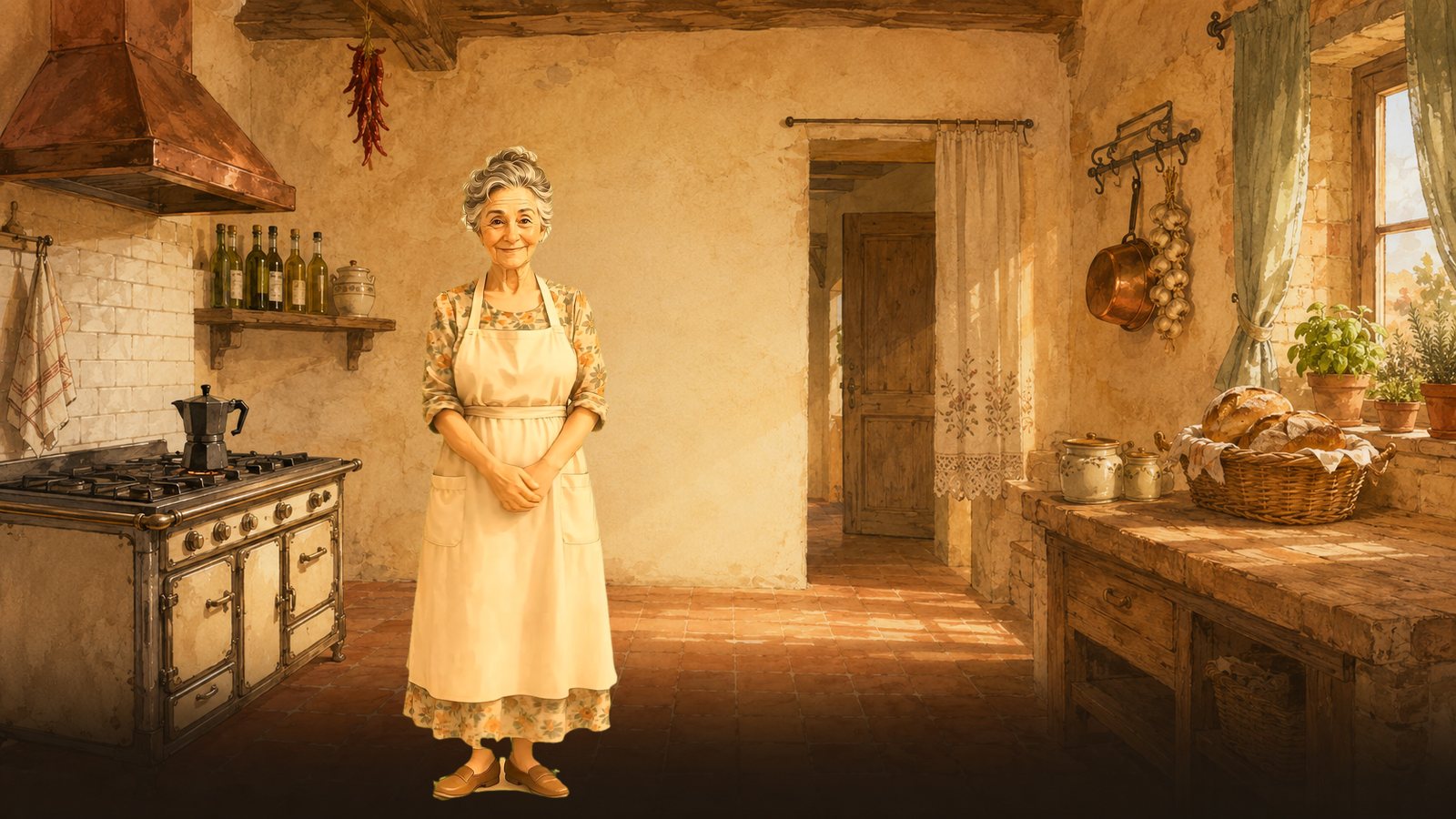
A small fictional world can make that repetition feel less mechanical. In the book from Stories with Sofia, Italian appears in short scenes with Sofia, her grandmother Elena, and their family, with English beside every Italian line. Seeing recurring people, places, and everyday needs gives phrases a reason to be there. You are not studying flashcards of stock photos. You are following what someone says, what they mean, and what happens next.
Say less, but say it clearly
English speakers sometimes rush Italian because they are trying to get through the sentence. Slow down instead. Italian vowels are usually pronounced clearly, and each one matters. In grazie, the final e is heard. In buongiorno, let each vowel have a little space.
You do not need an Italian accent to be understood. Aim for clarity, not performance. Say a phrase aloud after reading it. Then say it again a little later without looking. If it disappears, that is not failure. It is useful information about what needs another encounter.
Speaking practice can be private at first. Repeat a line while making coffee. Answer a question out loud before you read the response. Read a short exchange twice, taking one role and then the other. This is quiet progress, and it is often what makes a phrase available when a real person is waiting for your answer.
Build a personal set of phrases
The best Italian phrases depend on why Italian matters to you. A traveler may need directions and restaurant language. Someone visiting family may care more about come stai?, che bello vederti (“how lovely to see you”), and mi racconti di... ? (“will you tell me about...?”). If citizenship by descent is part of your reason, check the official requirements, but also make room for the language of ordinary connection.
Choose phrases from situations you can picture. Put them into a tiny scene rather than a bare list. Imagine arriving at Nonna Elena’s trattoria in Dozza: you greet her, ask how she is, order something to drink, and thank her. Or picture meeting Marta in Bologna and asking about her day. The details give your memory somewhere to place the words.
Start with what you would honestly want to say. A few familiar Italian phrases, met again and again in meaningful context, can carry you further than a notebook full of sentences you never use. The next time you hear one, pause and enjoy the small recognition: you understood it, and it belongs to you now.