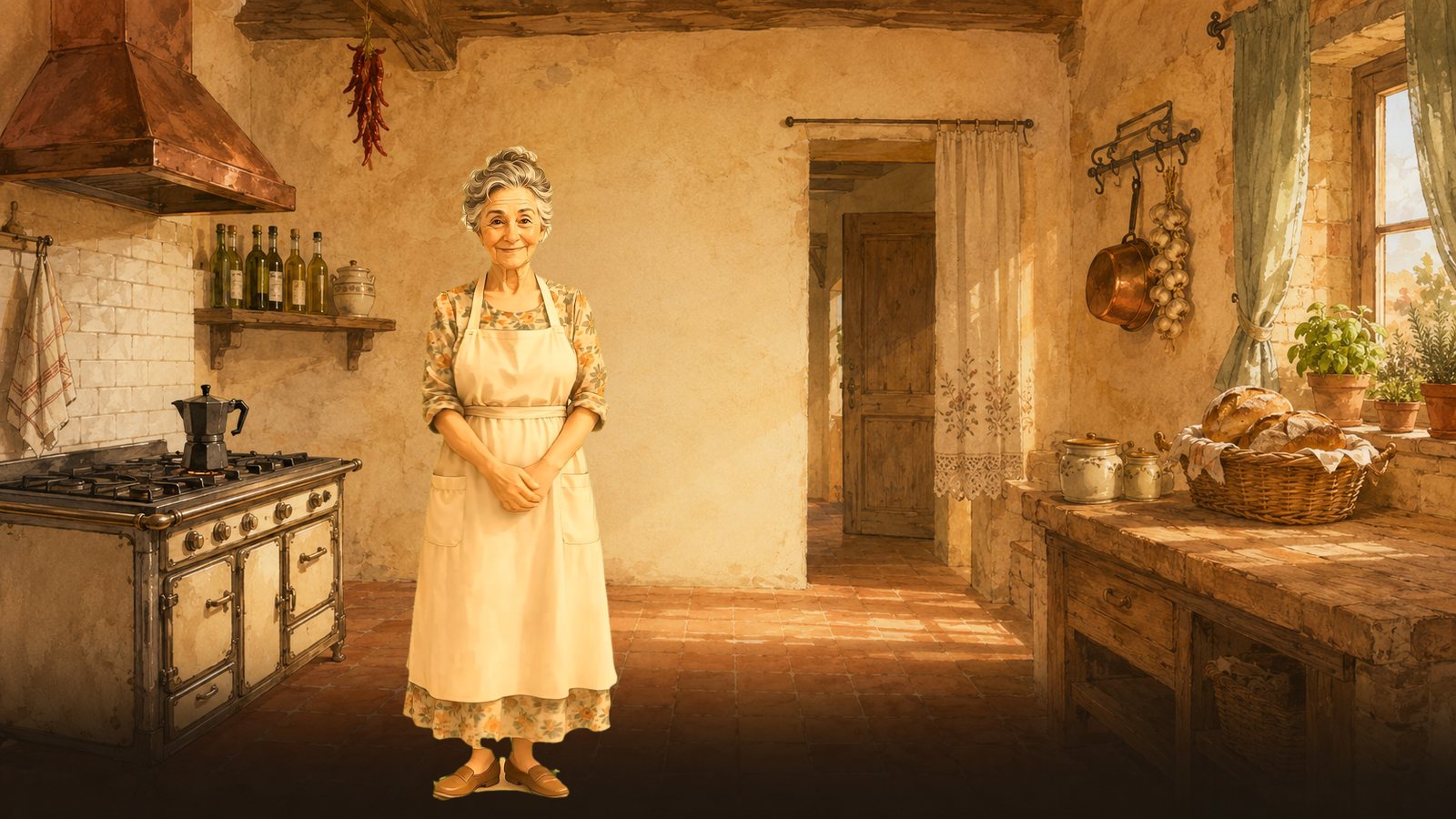
A grandmother says, “Mangia, mangia,” while setting down a plate of pasta. An uncle answers a phone call in rapid Italian. You understand the mood, a few familiar phrases, perhaps the names of foods and relatives. Then the conversation moves on without you. Italian heritage language learning begins in this tender, sometimes frustrating space: close enough to feel that the language belongs to you, but not yet able to follow it comfortably.
That experience is more common than many heritage learners realize. You may carry Italian in your ear without having much Italian available on your tongue. You may know a regional expression that never appeared in a textbook, or feel embarrassed that you cannot answer a simple question from a relative. None of this means you have failed. It means your relationship with the language has history, emotion, and a few missing bridges.
What makes heritage learning different
A heritage learner has some personal or family connection to Italian, but that connection can take many forms. Perhaps a parent or grandparent spoke Italian at home. Perhaps you heard it only during holidays, in the kitchen, or in calls with family abroad. Perhaps the family language was Sicilian, Neapolitan, Venetian, or another regional language alongside standard Italian.
This matters because heritage learners are not always beginners in the usual sense. You may recognize sounds, rhythms, and affectionate phrases quickly, even if connected speech still feels like a blur. At the same time, reading, spelling, vocabulary range, and confidence in conversation may be less developed than your intuition suggests.
There is also an emotional layer that a conventional course can miss. Learning Italian may be tied to a person you love, a family story, a place you have not visited, or a loss you cannot quite name. A grammar worksheet that asks you to conjugate verbs without context can feel oddly distant from that reality. Language becomes easier to keep when it is connected to meaningful people and scenes.
Start with understanding, not performance
Many heritage learners put pressure on themselves to speak right away. They want to call Nonna, visit family in Italy, or finally stop replying in English when someone speaks Italian to them. Those are beautiful goals, but forcing output before you can comfortably understand more language often leads to tense, exhausting study.
A gentler starting point is comprehensible input: listening and reading material that you can mostly understand, with enough new language to stretch you a little. This approach is closely associated with Stephen Krashen’s work on language acquisition. The central idea is simple: we acquire language through messages we understand, not by memorizing rules in isolation and hoping they become conversation.
For an Italian heritage learner, this can feel especially reassuring. You do not need to prove your Italian in every study session. You can spend time with a slow, warm little story about someone ordering a coffee, shopping at the market, or calling a sibling. Context, images, familiar routines, and repetition help you understand the new parts without translating every word.
When the message makes sense, your brain has something real to attach language to. Vorrei un cappuccino is no longer a fragile phrase on a flashcard. It belongs to a scene: Sofia is at the bar, she is deciding what to order, the barista is waiting, and you understand what happens next.
Why familiar stories build lasting Italian
Heritage language learning often benefits from stories because stories give vocabulary a home. A word such as borsa is easier to remember when a character cannot find her bag before leaving for the market. A phrase such as ha bisogno di becomes more useful when it returns later in several situations, each one understandable.
This is more effective than encountering a long list of unrelated words once and moving on. Researcher Paul Nation has emphasized that vocabulary knowledge grows through repeated encounters. Those encounters do not need to feel like drilling. In fact, the most durable repetition often feels almost invisible: you meet a word in a story, hear it again in another scene, read it in a short dialogue, and gradually recognize it without effort.
That is why a calm sequence matters. One lesson should not throw 40 new words at you because an app has decided that novelty equals progress. A smaller amount of language, returned to patiently across connected stories, gives you time to notice patterns and build familiarity. Quiet progress is still progress.
Stories also prepare you for the kind of Italian many heritage learners want to understand: connected, human language. Real conversation is not a set of isolated sentences. People interrupt themselves, repeat ideas, react, make requests, tell tiny stories, and refer to what everyone already knows. Beginning with understandable narratives helps your ear adjust to that flow before you face faster family conversation.
Make room for standard Italian and family Italian
A common question is whether heritage learners should study standard Italian when their family speaks a dialect or regional variety. The answer is usually yes, but without treating the family language as a mistake to be corrected.
Standard Italian can give you a widely understood foundation for reading, travel, media, and conversation with people from different parts of Italy. It is also the form most learning materials teach. But your family’s words, pronunciation, and expressions carry their own history. They may reflect a town, a migration story, or the generation that brought Italian across an ocean.
You do not have to choose one identity over the other. Learn standard Italian as a shared bridge, while keeping a small notebook or voice memo collection for family expressions. Ask what a word means, where it came from, and when people use it. If a relative says, “That is how your grandfather used to say it,” you have learned more than vocabulary.
Be prepared for variation. A relative may call something by a regional name, while your course uses standard Italian. Both can be useful. The goal is not to flatten your family’s voice. It is to understand more, communicate more freely, and recognize the many forms Italian can take.
A sustainable weekly practice
The best routine is one you can return to when life is busy. It does not need streak-panic, notifications that scold you, or an hour of intense study every day. For many learners, four or five short sessions each week are more sustainable than one ambitious weekend marathon.
Begin with a short, understandable story. Listen once for the overall situation rather than every word. Listen again while reading, and let the context carry you through what is new. A few gentle comprehension questions can be useful here, not as a test of worth, but as a soft confirmation that the story made sense.
Then revisit the same story later in the week. Notice one phrase you would like to use with family, such as Che cosa fai oggi? or Hai bisogno di aiuto? Say it aloud a few times in the context of the scene. If grammar catches your attention, look at it briefly after you understand the message. Grammar can clarify patterns, but it works best as a light switched on after you have already entered the room.
Finally, add one personal connection. You might write three simple sentences about a family meal, record yourself describing an old photo, or ask a relative about an Italian word they remember from childhood. Keep the task small enough that it feels welcoming. The point is not to perform perfect Italian. It is to let the language become part of your present life, not only your family’s past.
Stories with Sofia is built around this kind of experience: understandable Italian through emotionally warm scenes, slow audio, reading support, and deliberate re-encounters with language. One of its songs, Lontana e vicina, is Nonna naming her family near and far: her daughter in America, her grandson in Milan, her granddaughter at home with her in Dozza. For heritage learners, that can be a practical way to strengthen what is already there without reducing Italian to flashcards of stock photos.
Let conversation grow at its own pace
When you begin speaking more, expect a gap between what you understand and what you can say. That gap is normal. Receptive knowledge often develops first, especially for people who heard Italian around them as children. Your listening comprehension is not “fake” just because speaking takes longer.
Start with conversations that allow room to breathe. Tell a family member you are practicing and would appreciate slower speech. Ask one familiar question rather than trying to sustain an entire conversation. Repeat back a phrase you understood. Use Italian for a small ritual, such as a Sunday call, a recipe, or a greeting at dinner.
Some relatives may switch to English because they want to help, or because they are surprised to hear you try. You can gently ask for Italian again. Others may correct every mistake. If that makes you freeze, it is reasonable to say that you learn better when corrections are saved for one or two important things. A language relationship should make room for connection, not only correction.
The Italian you inherit does not need to arrive all at once. It can return in ordinary moments: the word for the spoon, a joke you finally understand, the warmth in a familiar goodbye. Give yourself enough understandable Italian, enough repetition, and enough patience for those moments to gather. Over time, the language may stop feeling like something just beyond the family table and begin to feel like a place where you can sit, listen, and answer back.