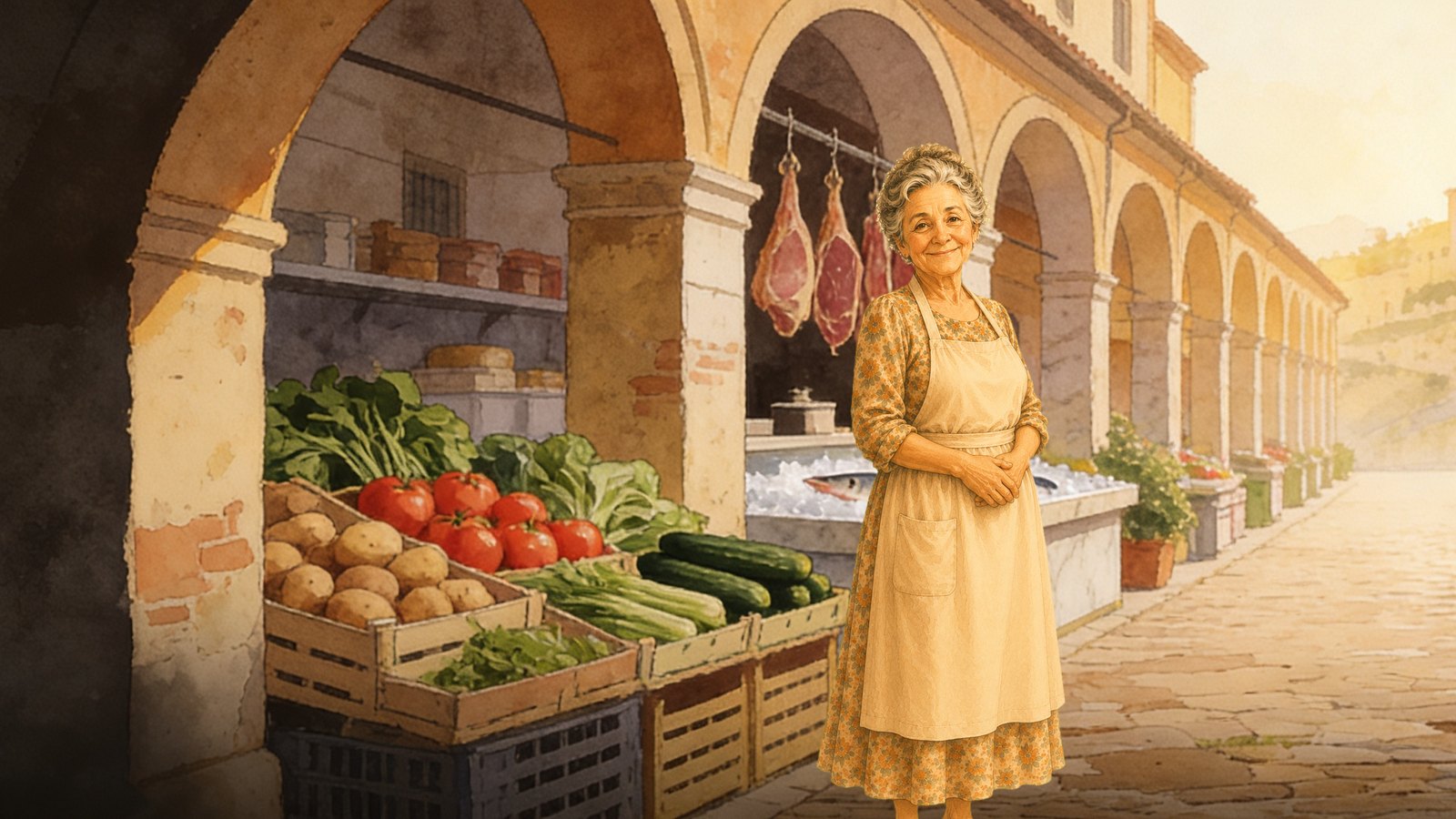
Imagine hearing la borsa in a story about Sofia leaving the house. She looks for her bag, finds it by the door, and heads to the market. A few minutes later, you hear it again: La borsa è pesante. The bag is heavy. Without stopping to force the word into memory, you understand it. That is the beginning of how to remember Italian vocabulary in a way that lasts.
Many learners have had the opposite experience: a neat deck of flashcards, a list of fifty words, and the strange feeling that yesterday’s study session has evaporated by breakfast. The problem is not that you are bad at memorizing. Isolated words give your brain very little to hold onto. Language is easier to remember when it belongs to a person, a place, a feeling, and a clear moment.
How to remember Italian vocabulary through context
A word becomes more memorable when it answers a real question in a scene. Why does Nonna need il pomodoro? Because she is making sauce. Why is Sofia saying ho fame? Because she has skipped lunch and can smell pizza from the bar next door. Meaning arrives before analysis.
This is the central insight behind comprehensible input, an approach associated with researcher Stephen Krashen. We acquire language by understanding messages that are just a little beyond what we already know. New vocabulary can appear in those messages, provided the surrounding language, image, gesture, or storyline makes its meaning clear.
Compare seeing affamato beside a stock photo and translating it as “hungry” with following a character who has been waiting for dinner for two hours. She opens the fridge. Nothing. She sighs, says sono affamata, and calls her friend. The second encounter gives the word a home. You may not be ready to use it perfectly yet, but you are far more likely to recognize it the next time it appears.
Context does not mean you should never check a translation. A quick confirmation can be useful, especially for an abstract or easily confused word. It means the translation should support understanding, not replace it. Let Italian arrive first as a meaningful experience whenever possible.
Meet words again, gently and often
One encounter is rarely enough. Even a word you understand clearly today may feel distant next week. That is normal. Durable vocabulary grows through repeated encounters spaced across time, not through one heroic cram session.
Language researcher Paul Nation has written extensively about the value of repeated exposure for vocabulary learning. The exact number of encounters varies. Familiar words, concrete nouns, cognates, and words tied to a strong emotional moment may settle in quickly. Less familiar verbs and small connecting words often need many more meetings. The useful question is not, “How many times must I see this word?” It is, “Will I meet it again in a meaningful way?”
A good Italian learning routine creates those returns naturally. You might hear prendere when Sofia takes the bus, read it later when someone takes a coffee, and encounter it again in a conversation about taking a photo. Each scene adds another shade of meaning. You begin to feel that prendere is a living, flexible word rather than a translation pair.
This is why random word lists can feel discouraging. They often ask you to recall a word before you have met it enough times to recognize it comfortably. Recognition is not a lesser skill. It is a necessary stage. First, you understand la finestra when someone opens it. Later, you notice it without help. Eventually, when you want fresh air, the word may come to you on its own.
Use stories to give vocabulary a memory hook
Stories are unusually kind to memory because they create connection. A sequence of events gives your brain a reason to pay attention: What does Sofia want? Will Nonna find the right ingredients? Why is the train late? Words are no longer floating alone. They are part of what happens next.
Emotion helps, too. A funny misunderstanding, a small moment of relief, the warmth of a family kitchen, or the tension of being late can make ordinary vocabulary easier to retrieve. This is not a trick. It reflects how human memory works. We remember experiences better when they matter to us, even in small ways.
Choose material you can mostly follow. If every sentence requires a dictionary, the story stops being a story and becomes a decoding task. If it is too easy, you may not meet enough new language to grow. The comfortable middle is material where you understand the situation and most of the words, while a few new ones become clear from context.
For beginners, short and slow stories are often more effective than jumping into a fast native-level show. A simple scene at a café can teach useful language deeply: ordinare, il conto, caldo, freddo, avere sete, pagare. When those words return in later scenes, they start to feel familiar in the best possible way, like people you have met before.
Listen and read the same Italian
Listening and reading together give vocabulary two paths into memory. When you read while listening, you connect the sound of cucina with its spelling and meaning. You also get support with the parts of Italian that can blur in connected speech, such as articles, endings, and short common words.
Try a simple cycle with one understandable piece of content. Listen once for the general situation. Read or listen again, noticing words that now make sense. Then return to it later, perhaps while walking or making coffee, without trying to catch every detail. Repetition feels less like drilling when you are revisiting a scene you already know.
There is a trade-off here. If you pause for every unfamiliar word, you may gain precision but lose the flow that makes language memorable. If you never pause, you may miss a word that keeps blocking comprehension. Aim for selective curiosity. Pause when a word is central to the scene, repeats several times, or genuinely interests you. Let the rest pass for now.
Let vocabulary become personal
After you understand a new word in a story, give it a small connection to your own life. If you hear il quartiere, think of your neighborhood. If a character says sono stanco, notice whether that is true for you after work. If you learn scegliere, quietly choose between two things in Italian: Scelgo il tè o il caffè?
This is not a demand to produce long sentences immediately. Early output can be light and private. A tiny mental response helps move a word from “something I recognize in Sofia’s story” toward “something I can use for my own meaning.” When you are ready, say a few simple sentences aloud, write a short message, or retell a familiar scene in your own words.
Be patient with words that remain passive for a while. You may understand magari in dozens of situations before it feels natural in your speech. Italian vocabulary does not move from unknown to mastered in a single leap. It often travels through a quieter path: first familiar, then recognizable, then available.
Build a routine without streak-panic
Consistency matters more than intensity, but it does not need to feel punitive. Fifteen calm minutes with understandable Italian most days can do more for long-term retention than an exhausted three-hour weekend session followed by silence.
A sustainable routine might include a warm little story, a second listen to an earlier one, and a moment to notice a phrase you liked. Stories with Sofia is built around this kind of deliberate re-encounter: everyday scenes return to useful language across reading and listening, with gentle checks that help you see what you understood. The goal is not to win a streak. It is to build familiarity.
If you enjoy flashcards, use them as a small supplement rather than the center of your learning. Save phrases from stories that already mean something to you, such as che bello! or non lo so. Keep the Italian sentence with a brief reminder of the scene. A card connected to a memory is more useful than a card connected only to a translation.
Some days, you will forget words you thought you knew. That is not failure or evidence that your study method is broken. Forgetting creates the need for retrieval, and meeting the word again strengthens the path back to it. Return to Italian with curiosity, let the stories carry some of the weight, and trust the quiet progress of words becoming familiar.