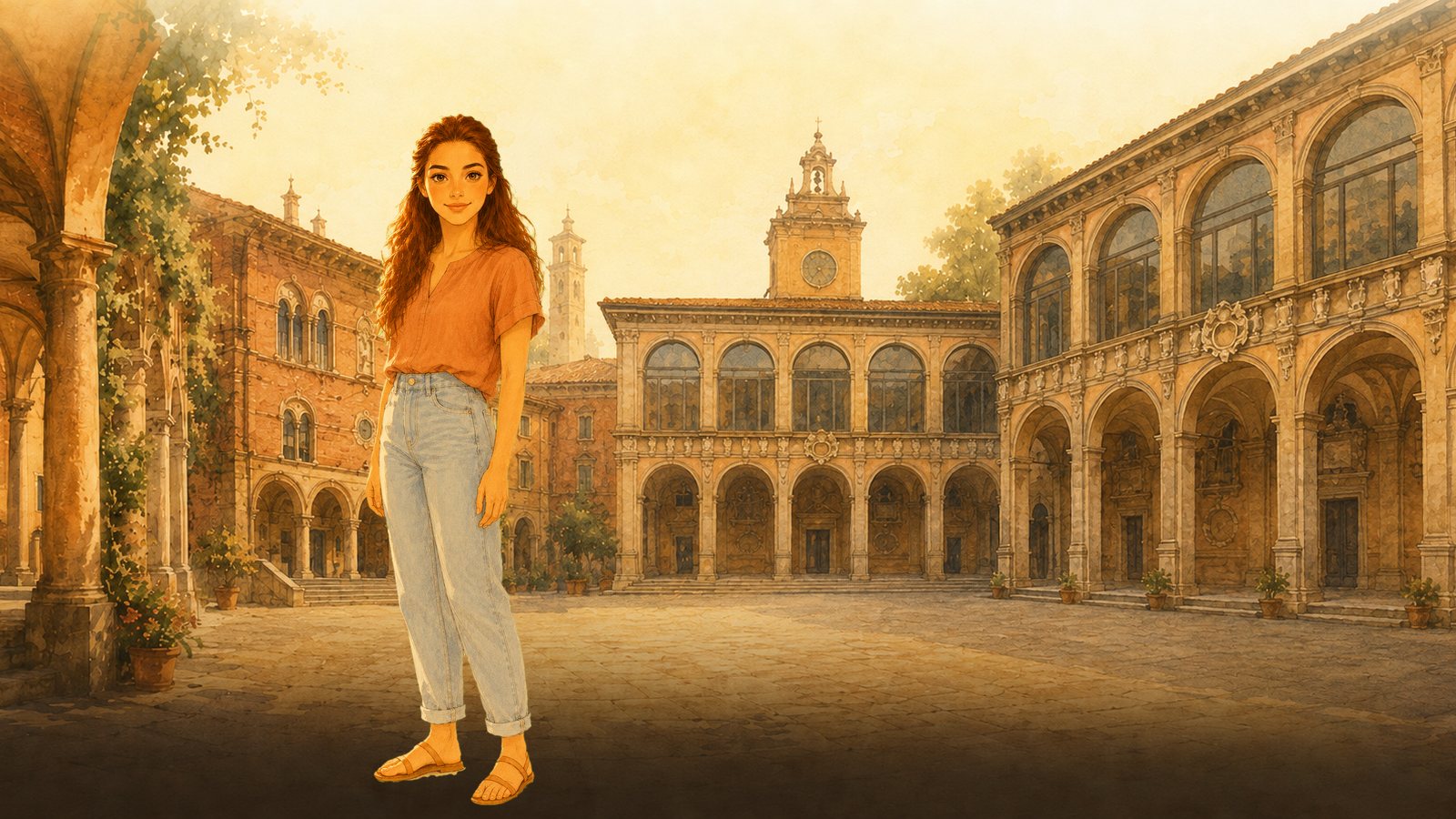
You are at a small bar in Bologna. Sofia asks for a coffee, the barista smiles, and someone at the next table is waiting for a friend. Without stopping to label every rule, you begin to understand why Sofia says voglio un caffè but later says sto aspettando un'amica. That is the quiet power of Italian grammar through stories: patterns arrive inside a moment that already makes sense.
For many learners, grammar has meant charts, exceptions, and a slightly guilty feeling when the answer does not come quickly enough. Grammar matters. But beginning with an explanation of the imperfect tense is not the same as being able to recognize it when Nonna tells you what the market was like when she was young. A story gives the form a job to do. It lets grammar carry meaning before asking you to analyze it.
Why grammar is easier when it has a story
Grammar is not a set of decorations added to Italian after the useful words are learned. It is the system that tells us who did something, when it happened, whether an action is finished, and how ideas belong together. The difficulty is that a rule on its own is easy to forget because it has no scene attached to it.
Consider the difference between seeing a worksheet prompt such as “conjugate andare in the present tense” and hearing: Ogni sabato, Nonna va al mercato. Compra i pomodori e poi torna a casa. Even a beginner can follow the small sequence. Nonna goes, buys, and returns. The repeated third-person verb endings are not abstract information. They are part of Nonna’s Saturday routine.
This is closely aligned with comprehensible input, an approach associated with researcher Stephen Krashen. We acquire more language when we can understand messages that are just a little beyond what we already know. The message comes first. Over time, the brain notices the recurring structures within it.
That does not mean rules are useless or that you should never ask why Italian works the way it does. It means explanations tend to help most after you have met a pattern in meaningful language. A short explanation can then feel like putting a name to something familiar, rather than trying to memorize a rule with nothing to hold onto.
Italian grammar through stories builds recognition first
At the beginning, a learner does not need to produce every verb form perfectly. They need to hear and read enough understandable Italian that forms start to feel recognizable. This is especially helpful with features that often frustrate English speakers: gender, articles, verb endings, and the many small words that change with context.
Take articles. A chart may tell you that il libro becomes i libri, while la borsa becomes le borse. In a story, Sofia looks for il libro, then finds two books and says, Ecco i libri! Later, she takes la borsa and notices le borse near the door. The shift is visible in the situation. You are not trying to remember random pairings of letters. You are following what is one, what is many, and what belongs in the scene.
The same is true for verb tenses. The present tense becomes familiar through ordinary actions: Sofia prepara la cena, ascolta musica, chiama sua madre. Then a past story creates a natural reason for a different form: Ieri Sofia ha preparato la cena. With enough encounters, you begin to hear that prepara belongs to what is happening or usual, while ha preparato looks back at a completed event.
There is a useful trade-off here. Stories are wonderfully effective for building comprehension and an instinct for patterns, but they are not magic exposure that requires no attention at all. If a form keeps confusing you, a brief, clear note can save frustration. The goal is simply to keep the note connected to a sentence you understand, then meet that pattern again later in new stories.
Repetition is not boring when the context changes
A single story can make a new structure understandable. Re-encounters help it stay with you.
Vocabulary researcher Paul Nation has emphasized the value of repeated meetings with words in meaningful contexts. The same principle helps grammar. If you see mi piace once, it may feel like a phrase to memorize. If you see it when Sofia picks out the fruit she likes at the market, when her brother Marco does not like olives, and when Nonna asks what the children like to eat, you begin to sense how it behaves.
You may also notice something important: Italian does not organize every idea in the same way English does. Mi piace la musica is closer to “music is pleasing to me” than “I like music.” A story lets you understand the intention first. After several gentle repetitions, the word order stops feeling like a puzzle and starts feeling like Italian.
This is why deliberate re-encounters matter more than cramming. A word or structure returns after you have had time to forget a little, then returns in a fresh but familiar scene. You recognize it, recover it, and strengthen the connection. That process is far kinder, and usually more durable, than trying to force fifty isolated examples into memory in one sitting.
Stories make difficult grammar emotionally legible
Some grammar patterns are hard because they express shades of meaning, not because learners are incapable of learning them. The imperfect tense is a good example. It often appears when a story describes a background, a habit, or an ongoing action: Pioveva e Sofia camminava lentamente verso casa. It was raining, and Sofia was walking slowly home.
A rule can describe this use accurately. Yet the rainy walk gives the imperfect its feeling. It creates the backdrop. If the story continues with Poi ha visto un gatto sotto una macchina, the completed event stands out against that background. You do not have to master the labels immediately to understand the contrast. First, you can feel what the language is doing.
Emotion also helps memory. We tend to remember the worried person who missed the train, the warm kitchen where Nonna is making soup, or the relief of finding a lost phone more readily than we remember a sentence designed only to demonstrate a pronoun. This is not a shortcut around serious learning. It is a serious learning advantage. Meaning, imagery, and emotion give language more than one path back into memory.
How to learn from a story without turning it into homework
A calm routine works better than trying to extract every possible lesson from one short text. Start by listening or reading for the situation. Who is there? What do they want? What changes? If you understand the thread, you have already done valuable work.
On a second pass, notice one recurring pattern. Perhaps Sofia says ho bisogno di several times, or perhaps characters use devo and devi while planning the day. Read the surrounding sentences rather than copying the form into a long list. Say one or two sentences aloud if that feels comfortable. The aim is familiarity, not performance.
Then let the story rest. When you meet similar language again, pause for a moment of recognition: “Oh, this is the pattern from the market story.” Low-stakes comprehension checks can be useful here. They offer a small confirmation that you followed the meaning without turning every lesson into a test.
At Stories with Sofia, this rhythm is intentional. The stories move slowly enough to be understood, with everyday details that make grammar useful rather than distant. You are allowed to listen again. You are allowed to understand before you can explain. That is not falling behind. It is how a foundation becomes steady.
When a grammar explanation helps
There is a time to open the grammar book. If you keep seeing ci, ne, or combined pronouns and cannot tell what is happening, a concise explanation can clear the fog. If you are preparing for an exam, explicit practice may also be necessary because exams often ask you to name and manipulate forms directly.
Use explanations as a map, not the journey itself. Read the rule, look at two or three sentences from a story, and return to understandable input. If the explanation makes you notice more on your next listen, it has done its job. If it leaves you staring at a table and feeling smaller, step back into the scene.
Italian grammar becomes less intimidating when it belongs to people doing ordinary, recognizable things. Spend time with their small plans, mistakes, meals, errands, and conversations. Soon, a verb ending will not be just a verb ending. It will be Sofia waiting at the bar, Nonna choosing tomatoes, and you quietly understanding more than you did yesterday.